BLABLA

Showing posts with label GuideLine. Show all posts

Tuesday, May 20, 2014


Survey of 1,000 coffee drinkers reveals which type are “people-pleasers” and which are the most laid-back.

 s
Black coffee drinkers are old-school purists who are patient and efficient but can be a little quiet and moody, finds a survey.
While latte drinkers were generous with their time but didn’t always take the best care of their health.
These are amongst the findings from a recent survey of 1,000 coffee drinkers conducted by clinical psychologist Dr. Ramani Durvasula.
The survey looked at different facets of personality along with the types of coffee which people expressed a preference for.
Here are the highlights:
  • Frozen/blended coffee drinkers were trendsetters who liked to try new things. While they tended to be spontaneous and imaginative, they could also be reckless and fail to make healthy choices.
  • Latte drinkers were people-pleasers and comfort seekers who would go out of their way to help others. On the other hand they didn’t always take care of themselves and could get over-extended.
  • Decaf/specifically ordered coffee drinkers tended to be more obsessive and perfectionist. They made healthy choices but also tended to be worriers overly-focused on order and control.

Brain Changes Associated With Casual Marijuana Use

Post image for Brain Changes Associated With Casual Marijuana Use

Brain region involved in reward, learning, pleasure and impulsivity may be affected by light marijuana use.
Young adults who smoked marijuana at least once a week showed changes in two brain regions associated with motivation and emotion, a new study finds.
The study, published inThe Journal of Neuroscience, compared the density, size and shape of the amygdala and nucleus accumbens in 20 marijuana users with 20 non-users.
The 18-25-year old marijuana users smoked the drug at least once a week, but were not dependent on it.
The comparisons between the two groups showed that the nucleus accumbens — an area involved in reward processing — was larger and a different shape in marijuana users.
Dr Carl Lupica, who studies drug addiction, commented:
“This study suggests that even light to moderate recreational marijuana use can cause changes in brain anatomy.

These observations are particularly interesting because previous studies have focused primarily on the brains of heavy marijuana smokers, and have largely ignored the brains of casual users.”

This study builds on previous research on animals showing that even relatively low doses of tetrahydrocannabinol (THC) — marijuana’s main psychoactive component — can cause structural changes in the brain.
This study comes soon after research which reviewed 120 studies on the effect of marijuana use on the teenage brain.
The conclusions of that report were that for those with particular vulnerabilities, like neuroticism and anxiety, marijuana is not as harmless as many assume.
Findings about the connection between marijuana use and very serious mental illnesses, like schizophrenia, have been unclear, with some saying it can be a causative factor in those who are vulnerable while others find little or no evidence.
Unfortunately, what we currently know about the effects of marijuana on the brain is mostly from heavy users of the drug.
This study hints, however, that even relatively causal use of marijuana may cause changes in the brain.
We don’t yet know what the implications of these changes are, but they certainly warrant further investigation.
Image credit: Peter Briones

Monday, May 19, 2014

What The Eyes Reveal: 10 Messages My Pupils are Sending You

 eye


The dilation and constriction of the pupils reveals how hard we’re thinking, how excited or disgusted we are and more…Our pupils, the black holes which let light into the eyes, don’t just help us see, they also signal what’s going on in our minds.
Here are 10 pieces of psychological research which show how changes in pupil size reveal many aspects of thought.


1. I’m thinking hard

Look into my eyes and ask me to name the cigar-smoking founder of psychoanalysis and you won’t see much change in my pupil size. The name Sigmund Freud comes easily to my lips.
But ask me to explain the laws of cricket and watch my pupils expand.
That’s because research has shown that the harder your brain works, the more your pupils dilate. When Hess and Polt (1964) gave participants more and more difficult tasks to complete, their pupils got bigger and bigger.

2. My brain is overloaded

Keep watching my eyes closely and you’ll spot the point when explaining the laws of cricket gets too much.
Poock (1973) reported that when participants’ minds were loaded to 125% of their capacity, their pupils constricted.

3. I’m brain damaged

The reason doctors and paramedics flash a light in patients’ eyes is to check their brains are working normally (and because it’s such an easy test to do). They use the acronym PERRL: the Pupils should be Equal, Round and Reactive to Light.
If my brain is broken, say, because I’ve had a bump on the noggin, you won’t see PERRL. There may well be other extremely subtle clues, like the blood pouring from my head.

4. You’re holding my interest

The size of my pupils can also signal whether I’m interested in what you’re saying.
White and Maltzman (1977) had participants listening to excerpts from three books: one was erotic, another involved mutilation while a third was neutral.
Their pupils widened at first for all three. But they only remained wide for the passages that were erotic or involved mutilation.
I’m likely to be interested in anything new, so my pupils will dilate a bit at first, but they’ll only stay dilated if I continue to be interested.

5. You’re turning me on

If things take a sexual turn then our eyes are also involved. Both men and women’s pupils expand when they are sexually aroused (e.g.Bernick et al., 1971).
However, not everyone agrees big pupils are a signal of sexual arousal. It tends to get tested by showing nude pictures to people and some argue that we’re just really interested in the nude form.

6. You disgust me

Just as my pupils increase in size when I’m interested or turned on, so they constrict when I’m disgusted.
Hess (1972) showed people pictures of injured children. First people’s pupils dilated because of the shock and then they constricted to try and avoid the troubling images.

7. Whether I’m liberal or conservative

Should you happen to be carrying around pictures of politicians you might be able to work out whether I’m a liberal or a conservative just from my pupil size.
Barlow (1969) showed people pictures of Lyndon Johnson, George Wallace and Martin Luther King, Jr.. The liberals’ pupils dilated when they saw fellow liberals Johnson and King but constricted when they saw conservative Wallace. Conservatives showed the opposite pattern.

8. I’m in pain

If you’ve had enough of this article now and want to cause me some pain in return, then why not stab me with a pencil? If you’re watching closely you’ll see my pupils dilate.
Chapman et al. (1999) fired small electric shocks into people’s fingertips and measured how much their pupils dilated. At maximum intensity the pupils dilated by about 0.2mm.
But that was only to a relatively tame current. Imagine what you could do to my pupils if you plugged me into the mains.

9. I’m on drugs

…and you can narrow down the type by looking at my pupils.
Some drugs, like alcohol and opioids cause the pupils to constrict. Others, like amphetamine, cocaine, LSD and mescaline cause them to dilate.
Police officers know this and some use it as one way of checking if someone is off their face. They generally look for pupils constricted to either less than 3mm or dilated to more than 6.5mm (Richman et al. 2004).

10. My personality

This one is not strictly related to pupil dilation, but it’s too good to leave out.
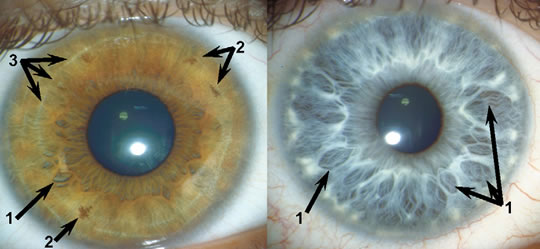
If you look closely at the coloured part of my eye, the iris, you might even get some clues as to my personality (Larsson et al., 2007).
Look closely for ‘crypts’ in my eyes (lines going away from the iris, labelled 1 above) and this suggests I’m a warm, tender-minded person. If you see furrows (labelled 3 above), then, watch out, I’m impulsive.
It seems that the same gene, Pax6, which affects part of the brain associated with approach-related behaviours (the left anterior cingulate cortex, if you really want to know) also induces tissue deficiencies in the iris.

Too small to see?

As you’ll have noticed, the same pupil response can mean different things, although generally when the pupils dilate it sends a positive message and when they constrict it’s a negative one. But exactly what it means depends on the situation (and whether someone has turned on a light).
This is all good fun to know, but can we really detect these tiny changes in people’s pupil size?
According to an fMRI imaging study, change in pupil size may be difficult for us to notice consciously, but we do seem to pick up on these very small changes unconsciously (Demos et al., 2008).
So changes in pupil size may be experienced, along with other verbal and nonverbal signals, as a gut instinct to either approach someone or run like hell.
Whether or not the eyes are windows to the soul, the pupils are certainly windows to the mind.
Image credits: maryaben & Larsson et al. (2007)
Sources:
www.spring.org.uk/2011/12/what-the-eyes-reveal-10-messages-my-pupils-are-sending-you.php

How to Take Notes You Will Remember

Post image for How to Take Notes You Will Remember

Laptop versus hand-written notes: what the difference reveals about memory.
A new study finds that if you want to better absorb concepts over the long-term, it’s better to take notes by hand.
Two psychologists were inspired to carry out the research after noticing a problem with recalling notes taken on a laptop.
Pam Mueller, a psychologist at Princeton University, found that switching back to a pen and paper from a laptop had been beneficial.
“Danny said that he’d had a related experience in a faculty meeting: He was taking notes on his computer, and looked up and realized that he had no idea what the person was actually talking about.”
The study’s co-author, Daniel Oppenheimer, had a similar experience, which Mueller explains:
“Danny said that he’d had a related experience in a faculty meeting: He was taking notes on his computer, and looked up and realized that he had no idea what the person was actually talking about.”
They set out to test this hunch scientifically by having 65 college students watch TED talks and then have them answer questions about what they’d learnt (Mueller & Oppenheimer, 2014).
 d


The questions, which were asked 30 minutes after watching the video, fell into two categories:
  • Factual-recall: for example, “Approximately how many years ago did the Indus civilization exist?”
  • Conceptual-application: for example, “How do Japan and Sweden differ in their approaches to equality within their societies?”
What they found was little difference in factual recall: people could remember about the same proportion of facts in both groups.
The big difference came in what people had understood conceptuallyfrom the lecture.
Here it turned out that the paper-and-pen note-takers had retained a significantly larger proportion of conceptual information.
The reason for this difference comes down to the mental processes involved in laptop versus hand-written notes.
It is likely that laptop note-takers tend to just transcribe what they are hearing verbatim, whereas hand-written note-takers engage more with the information.
“It may be that longhand note takers engage in more processing than laptop note takers, thus selecting more important information to include in their notes, which enables them to study this content more efficiently.”

Reminder Notes


This was borne out by the study’s results, which found that students whose notes had the least overlap with what was said in the videos, performed better in the test.
In other words: just transcribing stuff verbatim isn’t doing you much good.
Pam Mueller concludes with a warning:
“Our new findings suggest that even when laptops are used as intended — and not for buying things on Amazon during class — they may still be harming academic performance.”
Should you want to keep taking notes on your laptop, the best advice is to try and distil what the speaker is saying, rather than writing down phrases or sentences verbatim.
That’s because the mental act of processing information better embeds it into your memory.


Sources: 
Image creditKamilla Oliveira

www.spring.org.uk/2014/05/how-to-take-notes-you-will-remember.php
www.armymwr.com/backtoschool3.aspx

Friday, May 16, 2014


Benefits of a Hobby and Finding a Hobby

There are many advantages to having a hobby in your life. A hobby gives you time to relax, which can in turn, reduce your stress level. A physical hobby promotes exercise which will release endorphins which will boost your mood and awareness. Spending time on a hobby can also help you to find new skills and uncover hidden talents. If you are considering a career move, working at a hobby related to a new field can help prepare you and let you know if you're well-suited for that field. It would also give you great items to include on your resume. Depending on which hobby you choose, you may also meet new friends, keep your brain sharp, or make money.
For some, selecting a hobby may be a natural and easy process. For others, it can be confusing with where to start since there are so many options out there. This article helps to break down some of the options by areas of interest and personality type.

Hobbies that Sharpen the Mind

Some hobbies are better than others at making you problem-solve and think through tough scenarios. This can be especially important as you age. Here are some hobbies that can help to keep your brain in shape:
  • Jigsaw Puzzles, Crossword Puzzles and Brain Teasers
  • Card Games: Solitaire, Canasta, Gin Rummy, Bridge
  • Learn to draw or paint
  • Chess
  • Learn how to play an instrument
  • Master a New Language
  • Trivia Contests

Hobbies for Kids and Families

Here are some great hobby ideas for families. These hobbies are all kid-friendly!
  • Model Trains, Airplanes, and Automobiles
  • Scenic Travel by Train
  • Remote Controlled Toys for All ages
  • Building with Legos
  • Magic Tricks
  • Kite Flying
  • Zoos
  • Cruising the Seas
  • Puppetry
  • Juggling
  • Collecting (see section below)

Hobbies for the Physically Active and Adventure Seekers

For people who love to get the blood pumping and their heart-rate up, it is time to find an active hobby. Often times, hobbies that are more physical in nature often coincide with hobbies for adventure-seekers. Here are some great hobby options for the physically active:
  • Fishing
  • Noodling
  • Biking
  • Boating
  • Scuba diving and snorkeling
  • Hot air ballooning, flying, and gliding
  • Baseball or Softball Team
  • Volleyball
  • Walking
  • Hiking
  • Marathons
  • Mountain Climbing
  • Camping
  • RVing
  • Spelunking (caving)
  • Tennis
  • Golf
  • Horseback Riding
  • Skiing or Snowboarding
  • Dancing
  • Swimming
  • Football
  • Roller coasters
  • Traveling
  • Soccer
  • Bungee Jumping
  • Basketball
  • Triathlons
  • Geo-caching
  • Surfing and Wind Surfing

Hobbies for Science and Nature- Lovers

Did you enjoy Science in school? Do you like to explore and observe? If so, here are some hobby options for you:
  • Astronomy
  • Build Model Rockets
  • Microscopy
  • Bird Watching
  • Aquariums

Hobbies for the History Buff

Do you enjoy history and learning about our past? If so, here are some hobby options for you:
  • Study The Titanic
  • Americana Memorabilia
  • Become a Civil War Buff
  • Battle Reenactments
  • Visit Museums
  • Renaissance Fairs
  • Research and Create a Family Tree

Hobbies for Men

Let's face it, some hobbies are just better suited for men. Not saying that a woman cannot also enjoy these hobbies, but here are some hobby options for men:
  • Poker
  • Pool
  • Darts
  • Ping Pong
  • Woodworking
  • Sports Reporter
  • Sports Officiating and Referees
  • Fantasy Sports
  • Gadgets and Gizmos
  • Home Brewing
  • Hunting
  • Taxidermy

Hobbies that Can Earn Money

Everyone could use a little extra dough. Some hobbies have the potential to help you earn some extra money on the side as well. Here are some options:
  • Freelance Writing, Blogging, etc
  • Crafting (to sell online or at fairs)
  • Cake Decorating
  • Garage Sales and Auctions (to find bargains and antiques for resale)
  • Photography (Weddings, Babies, Freelance)
  • Carpentry
  • Graphic Design

Hobbies for the Collector

Collecting things can be a life-long passion. Collecting can help to stimulate memories and help to remember and preserve the past. People who collect often have a strong attention to detail and an urge for completeness. Here are some good ideas for collecting:
  • Beer Can Collecting
  • Book Collecting
  • Coin Collecting
  • Pin Collecting
  • Toy Collecting (Unique or Vintage)
  • Car Collecting (for larger budgets)
  • Art Collecting
  • Spoon Collecting
  • Sports Cards and Sporting Memorabilia Collecting
  • Autograph Collecting
  • Antique Collecting
  • Rock and Gem Collecting

Hobbies for the Homebody, Crafter, Artist, and the Nester

Are you expecting or have you recently had children? Do you love crafting and art? Are you unable to leave the house for any reason? Do you just enjoy being at home? Whatever the reason, here are some great hobby ideas for the homebody and nester:
  • Home Projects
  • Jewelry making
  • Baking
  • Painting
  • Pottery
  • Drawing
  • Candle Making
  • Reading
  • Soap Making
  • Cross stitch
  • Journaling
  • Digital Art
  • Cooking
  • Cooking Contests
  • Gingerbread Houses
  • Doll Making
  • Doll House
  • Scrap-booking
  • Knitting
  • Sewing
  • Crocheting
  • Quilting
  • Gardening
  • Movie watching and critiquing
  • Fen Shui
  • Interior Design
  • Writing (short stories, poems, novels)
  • Needlepoint

Hobbies for the Social

Are you a people-person? Do you enjoy meeting new people? Do you like activities that involve other people? If you answered "yes" to any of the above, here are some hobby ideas for you:
  • Wine Tasting
  • Flea Markets
  • Board Games and Trivia
  • Bingo
  • Bowling
  • Team and Club Sports
  • Book Club
  • Acting/Improve/Theatre
  • Frisbee Golf

Hobbies for the Music Lover and Musically Talented

Music is a fundamental part of life. Here are some great options for the Music Lover and Musically Talented:
  • Playing an instrument- Guitar, Piano, Drums, Clarinet
  • Singing and Choir
  • Concerts
  • Music History studies
  • Produce Music
  • Band Promotion
  • Teaching Music
  • Music Collecting (Records, 8-tracks, 45s)

Hobbies for Stress Relief

We could all use a little less stress and a little more fun! Here are some hobbies for stress relief:
  • Yoga
  • Meditation
  • Weight lifting

Seasonal Hobbies

Some hobbies can only be done at certain times of year. Here are some hobbies that are good for various seasons:
Spring
  • Home and Garden Shows
  • Springtime Floral Shows
Summer
  • Sailing
Fall
  • Haunted Houses and Hotels
  • Ghost Towns
  • Autumn Bike Tours
  • Fall Foliage
  • Apple Picking
  • Grape Harvest
  • Pumpkin Patch
Winter
  • Christmas Holiday Lights
  • Holiday Home Tours
Source: http://hubpages.com/hub/How-to-Choose-a-Hobby